
There is a point in every independent game developer’s life when the overarching question stops being, “How big can I make this game?” and instead becomes, “Why am I doing this to myself?”
I have officially reached that point.
After spending roughly 18 to 24 months developing my previous title, AlphaLink, I walked away with a tremendous amount of knowledge. Yet, the most critical lesson I learned had nothing to do with code or design pipelines; I simply realized I do not want to spend the next two years of my life repeating the exact same grueling cycle. This realization is not an indictment of long development timelines or the massive games that require them. Some projects legitimately demand half a decade of labor, and many creators genuinely thrive in those marathon cycles. I am simply discovering that I am not one of them.
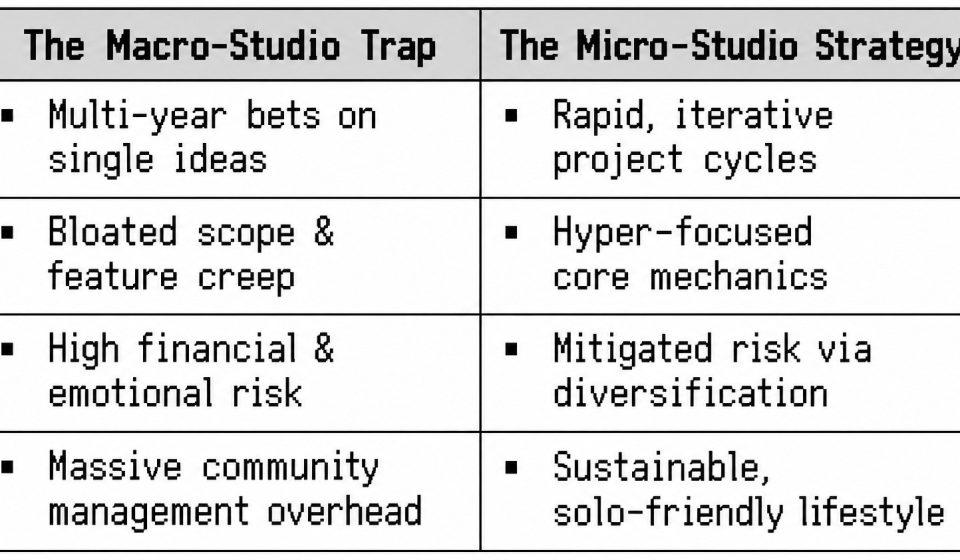
The modern game industry operates under a persistent, suffocating myth: that a game must be massive to be worthwhile. We are conditioned to believe that success requires more content, more systems, endless hours of replay-ability, and hyper-bloated feature lists. Driven by the theory that every added mechanic increases market value, scope creep quietly morphs a “fun little idea” into a monolithic production that swallows years of a creator’s life. I no longer want to sacrifice my time to that machine.
The Millennial Reality Check
Part of this shift stems from a logistical reality: I am no longer a 22-year-old developer with an empty calendar, an isolated keyboard, and a dangerous reliance on caffeine. Instead, I am a tired millennial balancing bills, a neurodivergent child, diverse hobbies, and a collection of farm animals with a blatant disregard for production schedules. My goats do not care about milestone deadlines; my chickens remain entirely unimpressed by agile sprint planning. The farm will not feed itself just because I finally managed to stabilize a procedural generation algorithm.
Beyond the demands of daily life, an oversized development cycle introduces a crushing creative opportunity cost. Time poured exclusively into one project is time stolen from everything else. It prevents me from experimenting with fresh concepts, writing articles, building utility tools, mastering new technologies, or shipping smaller, vastly more interesting games. When viewed through the lens of creative freedom, a multi-year development cycle stops looking like dedication and begins to feel like trapping all of my creative eggs in one fragile, overly complicated basket.
Critically, I am not convinced that players even want us to build these monuments. When evaluating game design from a consumer perspective, a stark disconnect emerges between industry assumptions and actual player behavior. Faced with a rare free evening, I rarely want to boot up a 40-hour campaign. More often, I actively seek out concise experiences that can be started and finished within a two-to-six-hour window. There is immense satisfaction in a game that identifies its core identity, executes it flawlessly, and gracefully exits.
Diversifying Creative Capital
This preference for brevity underscores a fundamental truth: length is not synonymous with value. A six-hour game is no less meaningful than a sprawling RPG simply because the credits roll sooner. We do not need every release to feature an open world, a complex crafting tree, a relationship simulator, and a fishing minigame. Sometimes, players just want a singular, compelling mechanic explored thoroughly enough to leave an impression. I know I do, and I can’t be the only one.
Shifting away from massive projects also makes practical business sense. Betting two years on a single title is an incredibly high-stakes gamble. If the game tanks, you lose two years of unrecoverable time. If it performs moderately, the returns rarely justify the opportunity cost of the projects you cast aside.
Alternatively, a short-cycle strategy allows a developer to make several smaller, diversified bets. Shipping a game in six months provides an immediate feedback loop. If one title underperforms, the loss is manageable. If another finds an unexpected niche, it can instantly inform the next project. The traditional industry mindset treats the completion of a massive project as the ultimate end goal; I argue that frequently finishing smaller projects is a far better way to generate long-term opportunities.
Focus Over Monuments
Ultimately, I have no desire to build a corporate monument. I am not trying to engineer the next billion-dollar live-service ecosystem, nor do I want to manage dozens of employees, handle community managers, or moderate Discord servers filled with players outraged over the physics of a cosmetic hat. I just want to make games I actually enjoy creating.
That sounds deceptively simple, but it is incredibly easy to lose sight of this goal when chasing wishlists, market algorithms, and revenue targets. If I force myself through a multi-year slog to satisfy perceived market demands, I haven’t built a sustainable business—I have just engineered a highly elaborate way to work a job I hate. The primary reason to pursue independent development is to command autonomy over our time. Recreating the exact corporate environment we fled is counterproductive.
Choosing a smaller footprint does not mean abandoning quality. It means prioritizing radical focus. A tight, constrained game can feature highly polished art, intentional sound design, and deeply satisfying mechanics without attempting to become an entire entertainment ecosystem. Most importantly, a focused game can actually be finished.
Finishing is a distinct skill in game development. There will always be one more feature to add, one more system to polish, or one more piece of content to expand. A healthy career requires knowing when to stop. I would much rather look back on a diverse body of finished, shipped work than realize a single project consumed the absolute prime years of my creative life. In this industry, sustainability will always be infinitely more appealing than being impressive. I just don’t want to get burn out again!


